
Dan Whitten
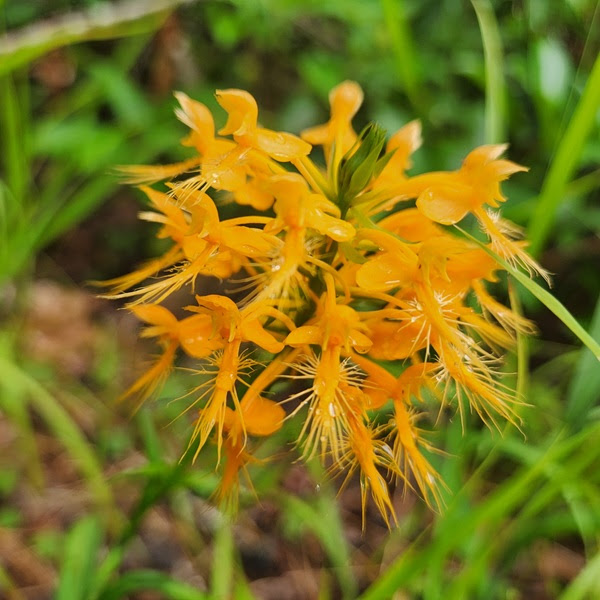
The first thing you might notice about the Yellow Fringed Orchid is that it may not be yellow at all, but more of a cantaloupe color. But sometimes flowers are actually more yellow than orange. So I would guess that Linnaeus–who first named the plant–was looking at the more yellow ones. Later the plant was renamed by Lindley (Platanthera ciliaris). It blooms from the bottom to the top and when the top most flower blooms, the bottom flowers are still fresh looking. It reminds me of a candle burning in the moist openings where it is found. It is common in the Coastal Plain, rare in the Piedmont and uncommon in the SC mountains. It becomes common again in the NC mountains. The spur is quite long and contains the nectary which is visited by butterflies and moths. A good diagnostic feature is that the lip has fine feathery fringing that is longer than the lip is wide. Two of the sepals form lateral wings and another sepal forms a hood. As each snowflake is different, so is the fringing of each flower. Several plants had been located by the JLT guides in the “duck pond” or “hidey hole” area of Lake Jocassee. I have been seeing posts from other wanderers of their finding the Yellow Fringed Orchids, but these on Jocassee were my first to see this year. That was certainly the “bright spot” of my day! ~Dan Whitten, JLT guide